


Executive function is not a diagnosis. It is how students access the world and show what they know.
EF coordinates perception, attention, working memory, and inhibition – so that instruction can actually land (Cordeiro, C. et al, 2020; Diamond, 2013).
Schools and Intervention Settings Often Solve Only Part of the Problem
In schools and outside intervention settings, we often focus on the visible skill deficit: speech and language, reading, writing, behavior, math.
But EF is the system that allows students to access those skills.
Research shows EF predicts academic achievement above and beyond IQ and is strongly linked to reading, math, and classroom functioning (Blankenship, T. L. et al, 2019; Best et al., 2011).

What This Looks Like for Students
A student may:
Understand phonics instruction but struggle to self-direct their attention long enough to apply it.
Know how to write a paragraph but lack the working memory to hold the structure in mind.
Understand expectations but struggle to initiate, plan, or inhibit impulses.
When executive function is underdeveloped, intervention may address the content – but not the access.
EF Starts at the Roots
Perception. Attention. Working memory. Inhibition.
These determine what is noticed, what is held in mind, and what actions are taken, shaping every aspect of learning and development (Schroer, S. E, & Yu, C., 2022).
As students grow, these roots support:
Planning
Organization
Time management
Flexibility
Emotional regulation
Independence.
Where Interventions Often Miss the Mark
Many executive function interventions miss the mark because they focus on surface-level strategies like planners, organization systems, and study skills without strengthening foundational executive function skills such as attention, working memory, inhibition, and cognitive flexibility. When these core processes remain weak, students may show temporary improvement, but difficulties with task initiation, regulation, and academic performance persist. Effective executive function support must target the roots of the system so higher-level skills like planning, organization, and independence can develop sustainably.
Time to Shift the EF Mindset
When we shift from, “Why isn’t this working?” to “What executive function demands are embedded in this task?” our lens sharpens.
Instruction becomes more precise.
Intervention becomes more effective.
Students become more independent.
EF is not an add-on; it is the system underneath learning.
When we strengthen the roots, everything above them grows.
*References at the bottom of the page.
The Sumpter Executive Function Framework
The Sumpter Executive Function Framework, or SEFF, is a developmental model for understanding, assessing, and supporting executive function in children. It is built on one core belief: executive function is the system underneath learning.
Rather than focusing on surface-level strategies, SEFF strengthens the foundational processes that drive development, regulation, and academic performance.
-
Executive function does not begin with planners or study skills. It begins with the roots:
Perception
Attention
Working memory
Inhibition
These processes determine what a child notices, how they sustain attention, what they hold in mind, and whether they can pause to plan. When the roots are under strain, higher-level skills such as organization, time management, and decision-making become inconsistent or fragile.
-
Executive function develops in layers.
Roots support regulation.
Regulation supports planning.
Planning supports independence.When we intervene only at the top, progress stalls. When we strengthen the roots, growth becomes sustainable.
-
SEFF is developmental, system-based, and practical. It shifts the question from “Why won’t they?” to “Which executive function process is under strain?”
It provides a clear lens for assessment, a structured pathway for intervention, shared language across home and school, and tools for direct skill-building.
-
The goal is not compliance.
The goal is capacity.SEFF equips children with the internal systems they need to regulate attention, initiate tasks, manage emotions, adapt to change, and learn independently.
When we strengthen the system underneath learning, everything above it grows.

Step-by-Step Executive Function Framework
The Executive Function Framework Being Put Into Practice by Professionals Worldwide
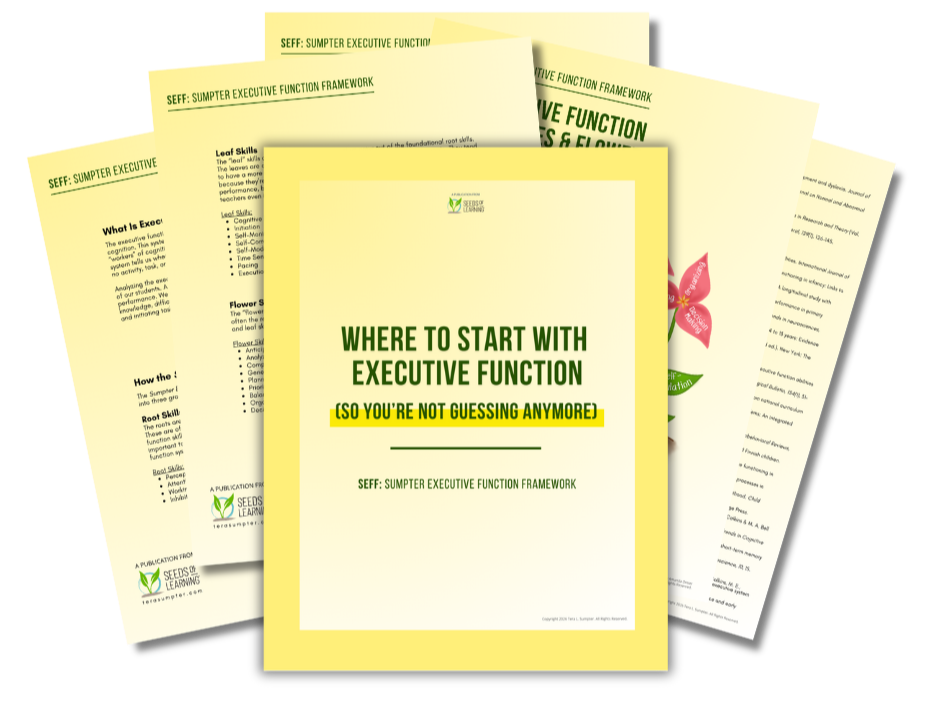
This guide walks you through the sequence of skills in my executive function framework, helping you understand the foundations so you can choose the best place to start.
-
Best, J. R., Miller, P. H., & Naglieri, J. A. (2011). Relations between executive function and academic achievement from ages 5 to 17. Learning and Individual Differences, 21(4), 327–336.
Blankenship, T. L., Slough, M. A., Calkins, S. D., Deater-Deckard, K., Kim-Spoon, J., & Bell, M. A. (2019). Attention and executive functioning in infancy: Links to childhood executive function and reading achievement. Developmental Science, 22(6), e12824.
Cordeiro, C., Limpo, T., Olive, T., Castro, S. L., & Almeida, L. S. (2020). Do executive functions contribute to writing quality in beginning writers? A longitudinal study with second graders. Reading and Writing, 33, 813–833.
Diamond, A. (2013). Executive functions. Annual Review of Psychology, 64, 135–168.
Schroer, S. E., & Yu, C. (2022). Looking is not enough: Multimodal attention supports the real-time learning of new words. Developmental Science, 25(3), e13290.