

What Is Executive Function?
Executive function is the director behind your child’s learning.
It’s the brain’s system that helps your child figure out what to do, when to do it, and how to do it. Think of it as the brain’s manager, guiding all the other parts so things run smoothly.
Executive function doesn’t just affect schoolwork; it affects how your child moves through their entire day.

Here’s what that looks like in real life:
Noticing what matters.
Executive function helps your child pay attention to the right things, like the teacher’s directions instead of the noise in the hallway.
Staying focused.
It helps them stick with a task long enough to finish it, even when it feels boring or challenging.
Remembering and using information.
Working memory allows your child to hold information in mind, like remembering the steps in a math problem or what sentence they were about to write.
Pausing before acting.
Inhibition helps your child resist distractions, wait their turn, and manage impulses, even when they really want to go first or do something else.
These are the foundational executive function skills. They are the building blocks. As children grow, these foundations support more complex skills like planning, organizing, managing time, problem-solving, emotional regulation, flexible thinking, and independent learning.
But executive function starts with the ROOTS: perception, attention, working memory, and inhibition.
Executive function isn’t about intelligence. It’s about access.
And the good news is this. These skills develop over time and can be strengthened with the right support, helping your child become more confident, capable, and independent at school and at home.
How Does Executive Function Show Up in My Child?
Executive function shows up in the small, everyday moments; not just the dysregulated ones.
It shows up in the morning rush when your child can’t seem to get started.
It shows up during homework when they stare at the page and say, “I don’t know.”
It shows up when a small problem turns into a big reaction.
It shows up all day when your child doesn’t appear to notice what is happening around them.
You might notice:
Difficulty with speech and language development
Difficulty with reading and writing, and other academic subjects
Trouble getting started, even when they know how to do the work
Forgetting directions or materials
Losing track of belongings
Big emotions when plans change
Difficulty waiting their turn
Seeming distracted or “tuned out”
Starting tasks but not finishing them
Needing lots of reminders
Executive function needs are often misunderstood as procrastination, defiance, or laziness.
Executive function is often overlooked when we think about common childhood learning needs such as dyslexia, dysgraphia, speech and language disorders, ADHD, and autism.
Your child may understand the content. But if their brain is still developing the systems for planning, organizing, regulating, and shifting, daily expectations can feel overwhelming.
Executive function challenges don’t mean your child isn’t bright and capable. They mean your child may need help understanding their own brain and learning how to direct it.
When we understand how executive function shows up, we stop asking, “Why won’t they?” and start asking, “What support do they need?”
That shift changes everything.


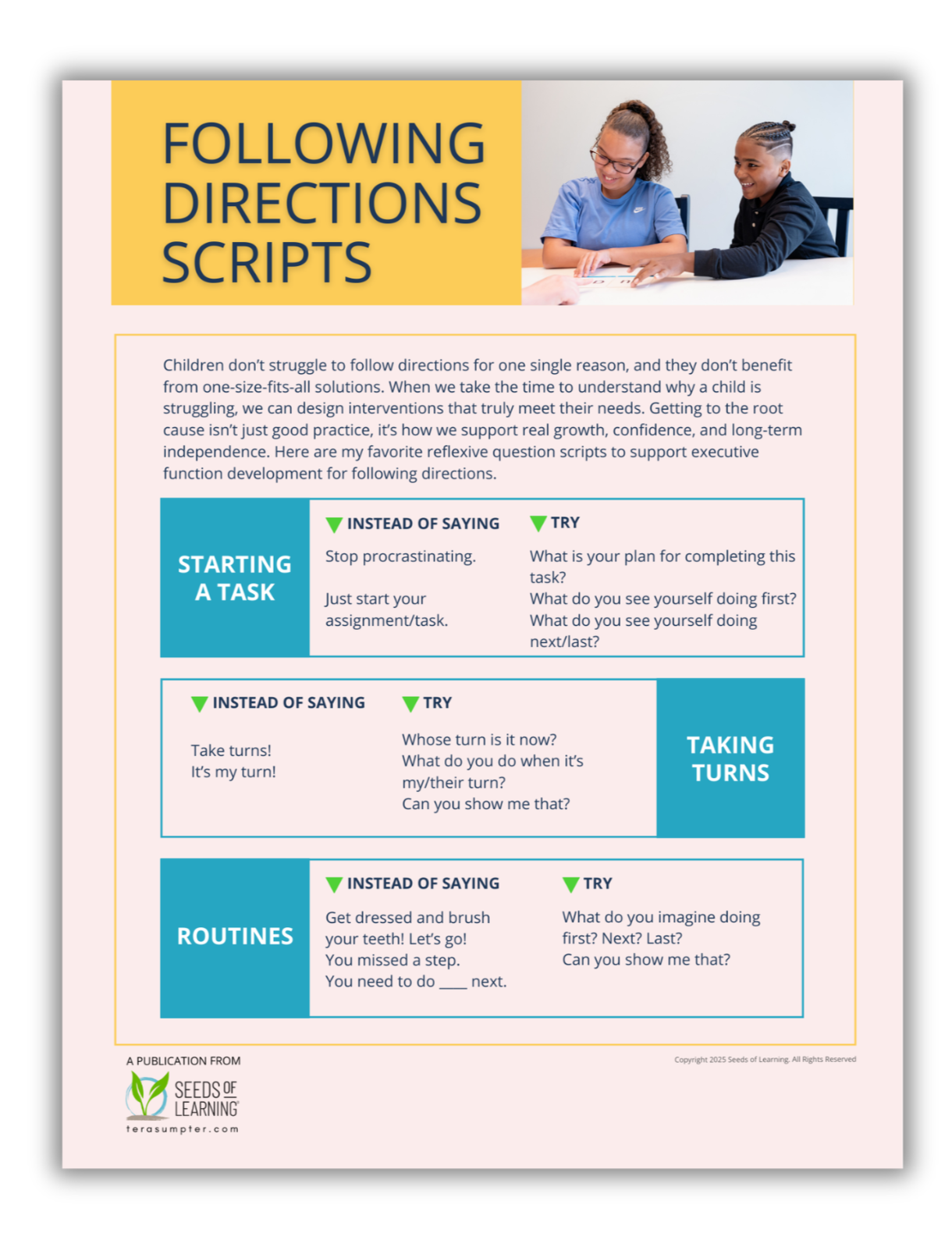
Reflexive Question Scripts to Strengthen Executive Function for Following Directions
The Executive Function technique that makes all the difference
These are my favorite reflexive question scripts to support executive function development for following directions.